


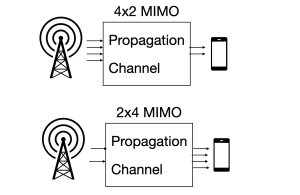
MIMO, or Multiple Input Multiple Output configurations, take advantage of having several antenna elements both at the transmitter and the receiver. It signifies that multiple input signals are transmitted through the propagation channel, while multiple output signals are received from that channel. These multiple antenna elements are standard in all transmitters and receivers. Depending on the count of inputs and outputs, the MIMO model can be represented as follows.
SISO – Single input single put
SIMO – single input multiple output
MISO – multiple input single output
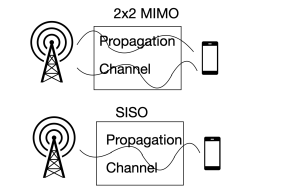
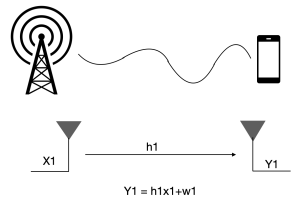
Here there is one antenna element each on both transmitter and receiver and the input signal x1 enters the propagation channel it tend to change in phase and amplitude as every EM waves and lets take change as h1. by the time when this signal x1 reaches receiver i.e output signal y1 as h1x1+w1, where w1 as hardware noise added on this course of reaching its destination.
The change h1 induced on the input signal will be decoded using reference signals like DMRS.
Benefits of MIMO:
- Transmitter diversity:
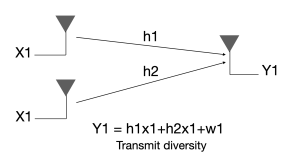
This method is crucial when the receiver has weak signal coverage and tends to miss information from the input signal. In such cases, the transmitter transmits the same signals from all antenna elements, aiding in the decoding of the input signal received through various paths. Consequently, the device (receiver) gains reliability at the expense of speed and throughput.
2. Spatial Multiplexing
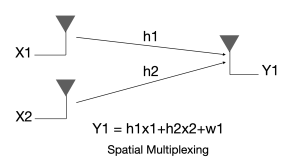
This method is crucial when the receiver has good coverage and can process more data from the transmitter. In order to increase throughput, the transmitter will send multiple input signals (x1 and x2) from all of the antenna elements which aids in decoding input signals from multiple paths. In this case, speed and throughput will be more advantageous to the device (receiver) than reliability from multiple streams from the transmitter.
Number of Data Streams/layers:
From the example below has transmitter has 3 antenna elements and on the receiver there are only 2 elements. here output can be rewritten as 2 equations written below which has 3 unknowns x1,x2 and x3 and maximum unknowns calculated from 2 equations are 2.
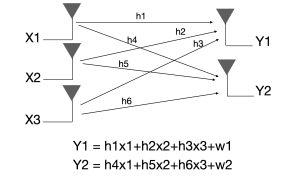
so that means number of layers limited to number of transmitting antenna elements and no of receiving antenna elements.
Max data streams/layers = min(nt, nr) i.e nt no of tx elements and nr no of rx elements.
ex: on the transmitting side we have 16T and 32T but on the receiving side we have 4 antennas elements. i.e the receiver has the capacity to download/decode from 4 layers only.
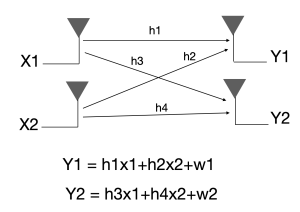
below is one example where though we have 2T and 2R on both side we cant decode both x1 and x2 by the receiver.so not all the time we can decode though on both sides it is 2T and 2R. i.e the receiver cant separate both x1 and x2 input signals.
Rank:
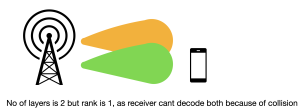
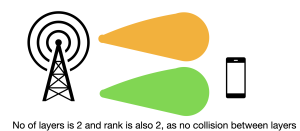
it is the no of layers from the transmitter which are completely independent and without any collision between them which will be decoded successfully by the receiver.
ref: 3gpp 38.211, 38.212 , 38.214



6 comments
https://shorturl.fm/DNeSD
https://shorturl.fm/tCgb6
https://shorturl.fm/5Rq1P
https://shorturl.fm/kSI3z
https://shorturl.fm/awCKO
https://shorturl.fm/35fH6
Comments are closed.